

Innovation has helped drive growth and improve lives across the G20, from advances in health and agricultural productivity to new energy sources and digital technologies. But markets often underinvest in innovation. This is especially true for health and climate, where the social value of new technologies frequently exceeds the returns innovators can capture. That is why governments should not rely only on subsidizing research upfront but should also make greater use of pull tools that reward results.
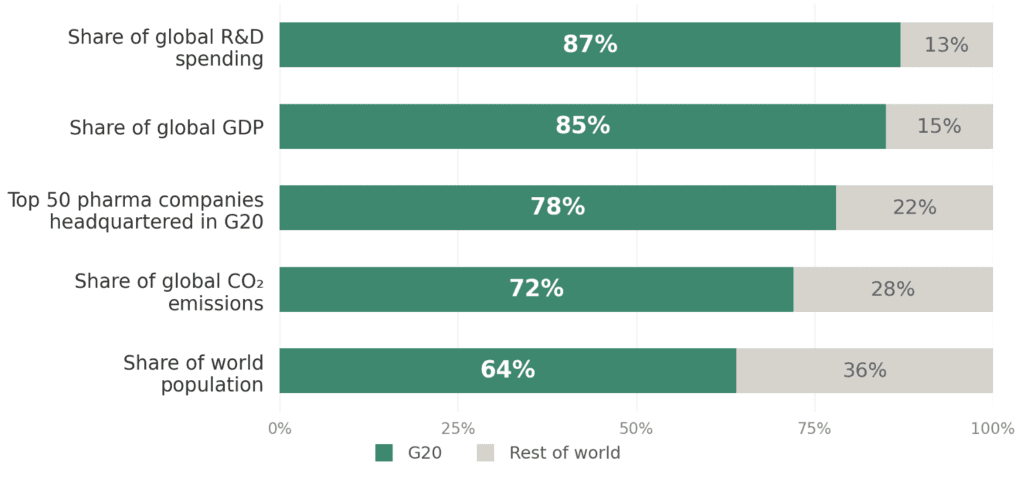
The G20 is especially well placed to make these investments. No single country has a strong incentive to pay for innovations whose benefits spill across borders—a new antibiotic or antiviral benefits everyone, not just the country that funds it. But with 64 percent of the global population, the G20 collectively is large enough to internalize cross-border spillovers from health and climate innovation, making coordinated investment worthwhile. G20 members also account for 87 percent of global R&D spending, 72 percent of CO₂ emissions, and are home to nearly four in five of the world’s top 50 pharmaceutical companies (see Figure 1)—meaning the G20 has both the innovation capacity to develop new solutions and the market weight to pull them to scale. The G20 also represents over 85 percent of global GDP and includes large middle-income countries where much of the growth in demand for health and climate technologies will occur, making it uniquely positioned to act.
Figure 1. The G20 has an outsized share of global output, emissions, and innovation capacity
Sources: WIPO Global Innovation Index, 2024; G20, 2025; Akashi et al., 2019
An underutilized tool: paying for outcomes
Pull mechanisms reward innovators for meeting a clearly defined target rather than subsidizing effort upfront. These tools include advance market commitments (AMCs), prizes, and advance purchase agreements. The logic is simple: governments or donors commit in advance to pay for a solution if it meets a prespecified standard. Innovators then compete to deliver it.
Pull mechanisms offer three big advantages.
-
They let governments pay for success, not just effort.
At a time of tight budgets, policymakers don’t have to guess which company or technology will succeed and place their bets upfront. They can define the outcome they want and pay when it is delivered.
-
They shift risk to innovators.
Pull funding works especially well when the end goal is clear, but the technical path is uncertain. Policymakers may know the product they want, but not who will build it or how. Pull mechanisms let firms take that bet, using their own knowledge of what is technologically feasible.
-
They can encourage scale and affordability.
Pull mechanisms can also be designed to reward not just invention, but real-world delivery. In particular, AMCs incentivize scale by offering a per-unit subsidy to the innovator—encouraging firms to think early about manufacturing, supply, and uptake. Because AMCs tie payments to volume at a capped price, they help resolve a central tension: incentivizing innovation while keeping products affordable. In other words, not just can it be invented, but can it also reach people?
One of the best-known examples (a G7 initiative) is the pneumococcal advance market commitment, which helped accelerate the development and rollout of vaccines for low-income countries that have saved hundreds of thousands of lives.
Three areas where the G20 could act now
The G20 has prioritized addressing antimicrobial resistance, scaling up investment in pandemic preparedness, and has committed to net-zero emissions by mid-century. Pull mechanisms can help deliver on these commitments by creating credible market incentives for the diagnostics, antivirals, and other tools that these declarations call for.
-
Antimicrobial resistance
Drug-resistant infections cause an estimated 4.95 million deaths per year worldwide, with the heaviest toll falling on low- and middle-income countries—and the burden is projected to be greatest in south and southeast Asia, home to several G20 members. Better diagnostics could help clinicians distinguish bacterial from viral infections and identify resistance more quickly. This would improve treatment and reduce unnecessary antibiotic use. But the market often under-rewards these products because much of their value is a public good: preserving the effectiveness of antibiotics.
CGD and the Market Shaping Accelerator have convened a working group, chaired by Lord Jim O’Neill, to design a pull mechanism for neonatal sepsis diagnostics. Similar approaches could also support other high-value tools, including diagnostics for urinary tract infections and respiratory illness.
-
Pandemic preparedness
The next pandemic will not wait for markets to get their incentives right. Two promising but underdeveloped areas are broad-spectrum antivirals and indoor air quality interventions.
Broad-spectrum antivirals could be enormously valuable in the early days of an outbreak, before vaccines or more targeted treatments are available. But firms anticipate that during emergencies, political pressure will push prices far below these products’ social value—weakening the incentive to invest ahead of time.
Technologies that curb airborne transmission could reduce the tradeoff between lives and livelihoods in future pandemics by allowing people to keep working safely, particularly for middle-income countries where most workers cannot work remotely. The technologies exist: tools such as far-UVC light, better filtration and ventilation, and other transmission-reducing interventions could substantially reduce the damage from future respiratory pandemics. But demand is uncertain, and the public health payoff is much larger than the private return any one buyer sees.
In both cases, pull funding could help create a credible market before the next emergency.
-
Low-carbon cement
As middle-income G20 members urbanize, cement demand will grow substantially. Cement is currently responsible for roughly 7 percent of global CO2 emissions, yet cleaner alternatives still struggle to scale. One reason is uncertain and fragmented demand: suppliers may not see a large enough reliable market to justify investment.
The G20 could help change that. Rather than funding R&D with no guarantee of results, governments could commit to rewarding verified low-carbon output. For instance, coordinated procurement commitments could reduce demand uncertainty for producers, while book-and-claim systems could help aggregate purchasing power across geographically dispersed buyers.
Not a silver bullet, but a serious tool
Pull funding isn’t right for every problem. It works best when the target is clear, success can be measured, and the reward is large enough to matter (Our pull incentive sizing tool can help with this). Design also matters. Policymakers need to think carefully about access, affordability, competition, and market structure.
But those are reasons to design these tools well—not reasons to ignore them. And pull funding shouldn’t replace push funding. In many areas, the right approach is a mix of the two: push support to help generate early-stage knowledge, paired with pull incentives to reward solutions that reach the market and deliver public value.
The G20 should lead
Where the social value of innovation exceeds the private return, paying for results can be a powerful way to unlock investment. Because these are cross-border challenges, coordinated G20 action is especially valuable. The G20 should lead this shift toward paying for results.
Thanks to Siddhartha Haria and the rest of the MSA team for helpful ideas and comments.