

Submission by: July 13, 2026
Food and Drug Administration
US Department of Health and Human Services
Re: Drug Repurposing for Unmet Medical Needs; Request for Information (Docket No. FDA-2026-N-4492; 91 Fed. Reg. 25897)
We appreciate the opportunity to respond to the Food and Drug Administration’s (FDA) Request for Information (RFI) on drug repurposing for unmet medical needs. We are economists whose work focuses on the economics of science, innovation, and incentive design. For nearly three years, in collaboration with the Duke Margolis Institute for Health Policy, we have studied how policymakers could properly incentivize drug repurposing.
We provide a detailed policy proposal for a drug repurposing incentive program in Question 3 and relatively brief responses to Questions 1, 2, and 4. Our response focuses on repurposing drugs that are no longer protected by composition-of-matter patents or relevant regulatory exclusivities, particularly where FDA-approved, therapeutically equivalent generic products are already commercially available. Once relevant patents and regulatory exclusivities no longer prevent generic entry, generic drug manufacturers can enter the market and drive prices down, making it difficult for a developer to recoup the cost of large clinical trials for a new use. As a result, without public funding, private companies are unlikely to finance the trials necessary to repurpose these drugs. For this reason, we believe government intervention is particularly warranted for this category of drug repurposing.
For ease of reference, we call this category “generic drug repurposing” and refer to these drugs as “generic drugs,” while recognizing that FDA generally uses “generic drug” more narrowly for products approved through an abbreviated new drug application (ANDA).
To incentivize companies to pursue promising new uses for generic drugs, we propose that a government funder, such as the Centers for Medicare & Medicaid Services (CMS) and/or the National Institutes of Health (NIH), use “pull” funding – a prize-like approach – to reward the successful discovery and development of a generic drug for a new use.
Pull funding rewards outcomes. This contrasts with “push” funding (i.e., traditional grant funding), which pays upfront for research regardless of whether it succeeds. In the context of generic repurposing, pull funding could reward developers who receive approval for a new use based on the drug’s estimated cost savings and/or health impact. This would motivate researchers to work on the most promising candidates, invest in large trials capable of gaining approval, and drive appropriate adoption.
1. Priority disease areas
We agree that FDA’s identified priority areas warrant attention, but we would encourage policymakers to prioritize disease areas with the largest opportunities for cost savings and improving health outcomes, including conditions where important unmet needs remain despite the availability of existing treatments.
From this perspective, attention should be paid to conditions associated with high healthcare spending, such as type 2 diabetes, joint pain and osteoporosis, oral disorders, and ischemic heart disease (IHME, 2025). Furthermore, consideration should be given to high-burden disease areas such as cardiovascular diseases, cancers, and neurological disorders, which account for the largest share of disability-adjusted life years (DALYs) in the United States (IHME, 2023).
Our core proposal, described in our response to Question 3, is to use pull funding, a prize-like approach, that pays companies when they repurpose generic drugs based on the estimated cost savings and/or health impact.1 Under this approach, policymakers would not need to identify target disease areas in advance. Instead, companies would naturally have incentives to pursue opportunities with large potential cost savings and/or health impact.
2. Candidates for drug repurposing
Below, we highlight seven drug-condition combinations that we encountered during the course of our economic policy research. Our core proposal, described in our response to Question 3, is not focused on any particular repurposing opportunity, but instead is to reward successful generic drug repurposing based on cost savings and/or health impact.
Nevertheless, examining promising repurposing opportunities was important for understanding how such a policy could work in practice and for estimating its potential health and fiscal impact.
We drew these examples from a broader list we compiled of repurposing opportunities pursued by the NIH, Advanced Research Projects Agency for Health (ARPA-H)-backed Every Cure, Cures Within Reach, academic literature, and other sources.
Scenario 1: Candidates where sufficient evidence may already exist
- Metformin, a type 2 diabetes treatment, for type 2 diabetes prevention (i.e., prediabetes) is one of the most compelling candidates for label expansion. The Diabetes Prevention Program, an NIH-supported randomized trial of more than 3,000 participants, established metformin’s effectiveness for prediabetes in 2002. Experts determined that the evidence was strong enough to list metformin in the US treatment guidelines for diabetes prevention, but it never received FDA approval. Adoption remains very low, at only ~2 percent of eligible patients. FDA approval could potentially help facilitate broader insurance coverage and adoption. Greater adoption could generate cost savings, as suggested by this systematic literature review of health economic evaluations of metformin for prediabetes and our estimates. We estimate that the expanded use of metformin for prediabetes could save Medicare roughly $90 million per year. This assumes that adoption expands from ~2 percent to 20 percent.
Scenario 2: Candidates for which there are preliminary signals from clinical data
These candidates have promising clinical evidence, but the available evidence may not yet be sufficient to support FDA approval.
For some of the four candidates listed below, large randomized trials are already underway. For others, further confirmatory trials may be needed once the ongoing, small studies report:
- Fenofibrate, a cholesterol drug, for diabetic retinopathy. A randomized trial with roughly 560 patients is underway, with results expected around 2029. Previous data were published in multiple studies, including the FIELD trial in 2007 and the LENS trial in 2024, but did not lead to FDA approval. Australia approved fenofibrate for this use, and clinical guidance in the United Kingdom supports fenofibrate for this use. This drug-condition combination potentially fits in Scenario 1.
- Fenofibrate, a cholesterol drug, for primary biliary cholangitis (potentially as a combination therapy). Small trials, such as this trial with 117 patients, have been conducted, and similarly sized trials, such as this trial with 184 patients, are presently being run. To support regulatory approval, a larger confirmatory trial may still be needed after the ongoing trials report. This cost-effectiveness analysis was performed in the context of the United Kingdom National Health Service and estimates cost savings.
- Pentoxifylline, a drug used to reduce pain caused by poor circulation, for diabetic kidney disease. Small trials have been conducted, and a large randomized trial is underway in the Department of Veterans Affairs (VA) system, VA PTXRx, with roughly 2,500 patients. Results are expected in 2029. This working paper provides a cost-effectiveness analysis for pentoxifylline for diabetic kidney disease in Medicare patients.
- Metformin, a diabetes drug, for multiple sclerosis (potentially as a combination therapy). Government- and philanthropically-supported trials are in progress, including PLATYPUS, with roughly 250 patients, and MACSiMiSE-BRAIN, with roughly 120 patients. To support regulatory approval, a larger confirmatory trial may still be needed after these trials report. We estimate that the use of metformin for multiple sclerosis could save Medicare roughly $50 million per year. This assumes that the drug achieves effectiveness similar to what was reported in early trials and 20 percent adoption.
The following candidates are supported by human observational evidence but do not yet have reported randomized trial results. Both have recently entered small clinical trials.
- Bumetanide, a diuretic, for Alzheimer’s disease. The trial is being run by Stanford University.
- Nucleoside reverse transcriptase inhibitors (NRTIs), a class of HIV drugs, for Alzheimer’s disease. The trial is being run by Butler Hospital.
Scenario 3: Candidates with preliminary signals but no clinical evidence
We did not search for candidates that fit in Scenario 3. However, organizations, EvE Bio and EveryCure have to some degree.
3. Approaches to identifying candidates for drug repurposing
This section sets out our core proposal: a government funder, such as CMS or NIH, would use pull funding to reward the successful discovery and development of new uses for generic drugs. Section 3.1 gives an overview of our approach, Section 3.2 explains the motivation for our approach, Sections 3.3 and 3.4 describe how the approach works in more detail, and Section 3.5 discusses potential agency hosts.
3.1 Overview of our approach
We propose a pull funding mechanism that rewards successful generic drug repurposing based on estimated cost savings and/or health impact. Unlike push funding, which pays for research upfront, pull funding only pays based on outcomes.
Once patents and regulatory exclusivities no longer prevent generic entry, competition drives prices down, making it difficult for developers to recoup the cost of clinical trials for new uses. Private companies are therefore unlikely to finance generic drug repurposing without public or philanthropic support. A pull mechanism would close this incentive gap by rewarding successful development.
Government funding approaches:
- Push funding: upfront funding (e.g., a grant for a clinical trial).
- Pull funding: funding based on outcomes (e.g., a prize for a developer that gets approval for a new use).
Our proposed pull funding mechanism has several core principles (see Figure 1):
Figure 1. Core design principles
| Principle | Description |
|---|---|
| Payments linked to value | Rewards are based on estimated cost savings and/or health impact (e.g., a share of savings to Medicare and Medicaid, or a fixed amount per disability-adjusted life year (DALY) averted). Cost savings and health impact would depend on the real-world, incremental adoption of the drug. Spending caps could be used to protect the funder’s budget. |
| Reward goes to the sponsor | The developer that runs the trials and obtains the approval for the new indication is the one rewarded for the estimated adoption of this new use, regardless of which manufacturer sells the drug to the patient. Other manufacturers could continue selling the drug at competitive prices. This dynamic allows the program to reward the developer that funded the repurposing trials without limiting generic competition or increasing prices.
We anticipate that a wide range of developers could participate, including pharmaceutical companies focused on research and development (R&D), generic drug manufacturers, startups, universities, and nonprofit organizations. Under current regulatory pathways, university or nonprofit researchers would potentially need to partner with, license the opportunity to, or form a company capable of sponsoring the application and maintaining the approval. These organizations could nevertheless identify opportunities and apply to the program before securing a partner. |
| FDA approval as a qualifying criterion | FDA approval is the clearest assurance of safety and effectiveness, and it also can play a major role in driving adoption, since it supports insurance coverage and allows developers to promote its use. 2 We believe FDA approval could be pursued through a supplemental new drug application (sNDA) by the holder of an existing new drug application or, for an independent developer, through a 505(b)(2) new drug application (NDA). |
| Any drug, any disease3 | We propose that the funder reward whichever combinations developers successfully bring forward, rather than selecting the combinations itself. This crowdsources the difficult task of choosing among thousands of conditions or tens of millions of possible drug-condition combinations.
Additional work is needed to define the program’s precise scope so that eligibility is limited to opportunities lacking sufficient private-market incentives. One practical starting point could be small-molecule drugs with at least one marketed generic approved through an ANDA. The mechanism could potentially be expanded to other categories, including biologics with biosimilar competition and combination products, but those cases would require further assessment. We believe there is a strong case for the “any drug, any disease” principle, but this principle is not necessary to implement the proposal. |
Source: Market Shaping Accelerator
3.2 Motivation for using pull funding
Pull funding complements push funding and existing initiatives.
Much of the relatively limited funding currently available for generic drug repurposing comes through grants or other forms of push funding, which require government or philanthropic funders to commit substantial resources upfront to selected drug-condition combinations before trial outcomes are known.4
By contrast, pull funding allows government funders to pay only when a project succeeds. Developers and investors decide which opportunities to pursue and bear the costs and risks of development, giving them strong incentives to select promising targets, design trials capable of supporting approval and adoption, and promote appropriate uptake after approval.
Pull funding is analogous to how the patent system incentivizes new drug development. Companies weigh the likelihood of success, development costs, expected returns, and projected adoption before deciding whether and how to invest.
Rather than funding a specific project at a specific point in time, our pull funding proposal suggests creating a standing expectation that developers could earn a return. This incentive structure could encourage developers to use privately held information and invest in capabilities that become worthwhile only if they expect to pursue repurposing opportunities repeatedly. This could include analyzing unpublished clinical trial data and real-world data, as well as using computational biology tools to identify repurposing targets.
Expert interviews and desk research suggest that this information and these capabilities are dispersed across pharmaceutical companies focused on R&D, generic manufacturers, universities, nonprofits, startups, clinical networks, and others. The program should therefore be open to a broad range of actors who could then coordinate with each other. Large pharmaceutical companies focused on R&D and generic manufacturers, in particular, may hold especially valuable clinical trial data, real-world evidence, regulatory expertise, and development capacity, while other participants may bring different information and capabilities5.
The proposed mechanism would complement rather than replace existing US government initiatives. For example, Project Renewal and the authority granted under Modernizing the Labeling of Certain Generic Drugs (MODERN) are well-suited to uses already supported by substantial existing evidence, such as those that stakeholders identify in Scenario 1 of Question 2 of this RFI. Pull funding may be better suited to promising opportunities that still require substantial evidence generation, including costly clinical trials.
For these reasons, pull funding could complement existing government efforts by supporting the opportunities that require substantial evidence generation but are unlikely to advance under present-day financial incentives.
3.3 Step-by-step illustration of the pull funding mechanism
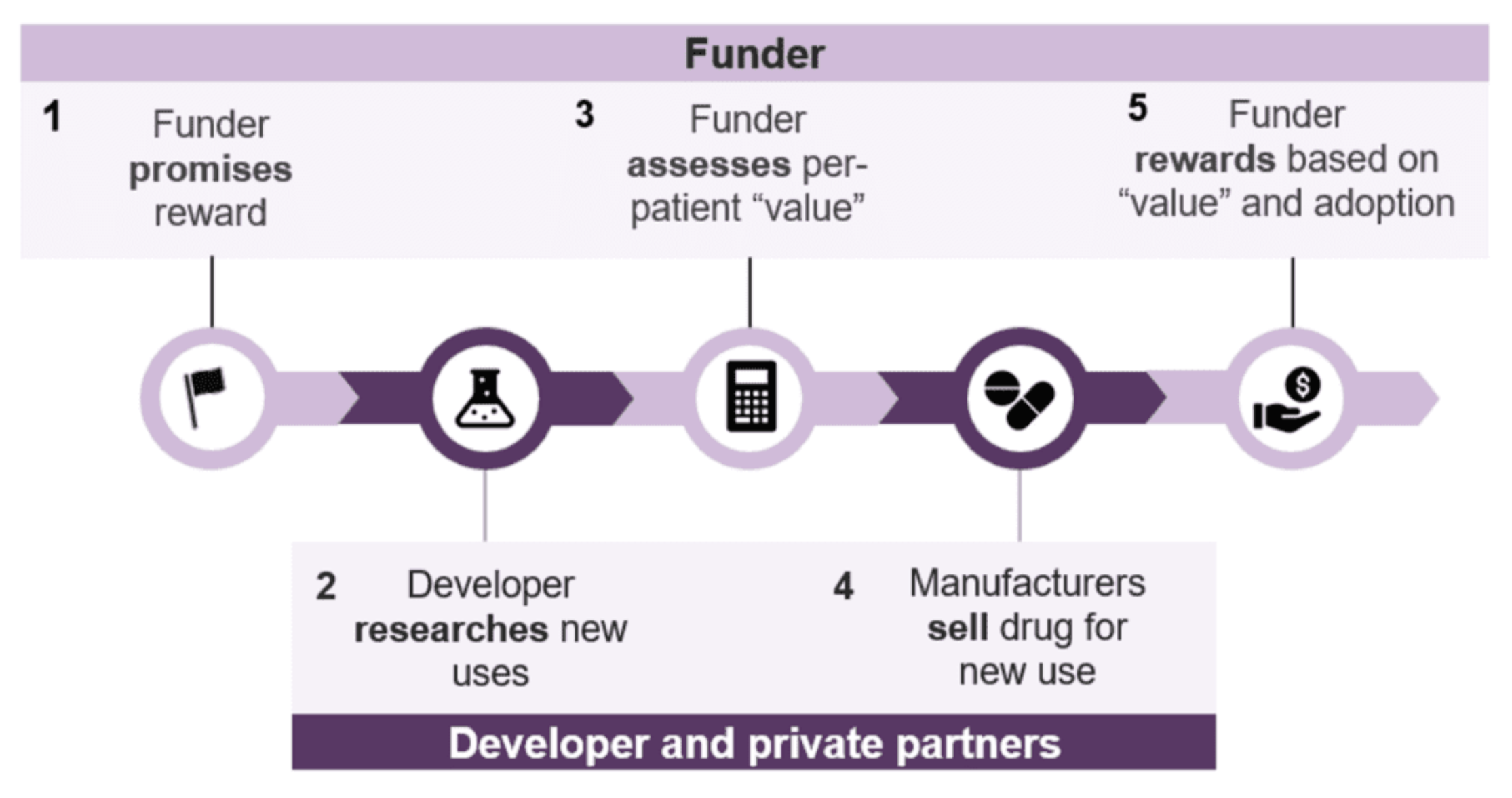
The pull mechanism would operate through five steps: promise, research, assess, sell, and reward (see Figure 2). Below is a description of how this could work in practice. While multiple organizations could host the pull mechanism and structure it in different ways, we illustrate the proposal by describing a cost-savings program hosted by a group within CMS, the Center for Medicare and Medicaid Innovation (CMMI). FDA could support the program in multiple ways. We discuss potential agency roles and authorities in more detail in Section 3.5.
Figure 2. Pull funding could involve a five-step process
Source: Market Shaping Accelerator

Step 1. Funder promises a reward
CMMI, in consultation with FDA, would publish clear guidelines for generic drug repurposing: a developer that secures FDA approval for a new indication of a generic drug would become eligible for a defined number of years, such as ten years, of payments tied to estimated cost savings.
At launch, CMMI could publish statistics that help developers understand how clinical outcomes could be translated into savings. For example, CMMI could publish information on average treatment costs, hospitalization rates, relapse rates, and disease incidence for relevant conditions. These data would help developers understand how outcomes, such as fewer relapses, might translate into estimated value.
Step 2. Developer submits and researches new uses
Suppose Developer X sees promise in studies suggesting that metformin, a diabetes drug, could help patients with multiple sclerosis. Before investing in a costly Phase 3 clinical trial, Developer X would submit the proposed drug-condition combination to CMMI. At a minimum, the submission would need to specify the drug, dose, route of administration, and proposed indication. FDA could advise on contract terms, including whether the developer also needs to define other criteria, such as the relevant patient population and endpoint selection.
There are several ways to structure this submission process, which we discuss further in Section 3.4. For purposes of this example, we assume that developers submit drug-condition combinations directly to CMMI. For simplicity’s sake, we also assume that – in this specific example – no other developer submits the same drug-condition combination.
Following Developer X’s submission and the lack of competitor submissions, CMMI would enter into a contract with Developer X. The contract would give the developer exclusive eligibility for the reward for that drug-condition combination for one year. If the developer starts trials during that period, it would have several additional years of exclusive eligibility for the reward. The contract may also specify how trial results would be translated into estimated per-person annual cost savings and the percentage of savings that the developer will receive, say 50 percent of the savings.
After signing the contract, Developer X would post a refundable deposit. The deposit would be returned with interest after the developer demonstrates an effort to run the trial, but could be forfeited if the developer fails to meet specified development milestones without an approved extension. We discuss this further in Section 3.4.
Next, Developer X would conduct the clinical trial and publish the required clinical trial data.
Step 3. Funder assesses per-patient value
Assume that Developer X’s trials show that metformin delivers a clinically meaningful benefit, that Developer X submits a 505(b)(2) new drug application, and that FDA approves the new indication. A third party would then use the clinical trial data and the prespecified contract terms to estimate the annual cost savings per treated patient. In this example, let us assume that savings are roughly $5,000 per patient per year. This metric would be used as an input in the payment calculations.
Step 4. Manufacturers sell the drug
After approval, patients begin purchasing the drug for the new use, and generic manufacturers continue selling the drug at market prices. CMMI, perhaps with assistance from an independent, third-party analytics company, would measure the incremental adoption for the new use each year using claims, prescription, or similar data. In this instance, imagine CMMI estimates that 40,000 Medicare beneficiaries used the drug for the new indication in the given year. This metric would be used as an input in the payment calculations.
A more speculative way to measure adoption is to use the FDA Sentinel System. The Sentinel System is designed to use large-scale healthcare data to monitor medical product safety, not to administer pull funding payments. However, if legally and operationally feasible, it could potentially help estimate real-world use of rewarded indications.
Tying rewards to adoption is important because it helps align rewards with real-world value. If the government used a lump-sum prize instead of an adoption-based reward, it could unintentionally incentivize developers to pursue drugs that meet the technical requirements for approval but are unlikely to be widely used or meaningfully improve care. Tying rewards to adoption encourages developers to consider whether patients, clinicians, and payers will actually use the drug. For example, it creates incentives to prioritize features such as oral rather than intravenous administration or once-daily rather than multiple-daily dosing.6
Step 5. Funder pays based on value, scaled by adoption
The annual payment would be the product of three factors:
Annual payment = estimated benefit per patient × patients treated × payment multiplier
The estimated benefit per patient component is described in step 3, and the number of patients treated component is described in step 4. The payment multiplier, described in step 2, is specified in the contract and determines the percentage of estimated savings the government will distribute to developers. An auction process, which we describe in Section 3.4, could allow companies to bid the payment multiplier down.
Figure 3 below illustrates payment calculations. The cost-savings program is illustrated in the “Option A” column. Assuming the estimated savings are $5,000 per patient, 40,000 patients are treated, and the 50 percent payment multiplier is used, the annual payment is approximately $100 million. This would leave $100 million in annual savings as surplus to the payer, CMS. The “Option B” column shows how a comparable health-impact program, perhaps implemented by NIH, could be structured. In this example, 40,000 treated patients each gain 0.25 DALYs, generating 10,000 DALYs of annual health benefit. At $20,000 per DALY, this also represents $200 million in annual value, of which 50 percent is paid to the developer. We believe this hypothetical scenario offers sufficient reward to attract developers.7
Figure 3. Illustrative examples of payment option calculations
| Option A: Payment based on cost savings | Option B: Payment based on health impact | |
|---|---|---|
| Benefit per patient | $5,000 | 0.25 disability-adjusted life years (DALYs) averted. |
| Monetary value per patient | $5,000 | $5,000
Assuming one DALY is valued at $20,000, then 0.25 DALYs is worth $5,000. |
| Patients treated | 40,000 | 40,000 |
| Proportion of the “value” generated that is rewarded to developers | 50% | 50% |
| Annual payment | ~$100 million | ~$100 million |
Source: Market Shaping Accelerator
3.4 Determining reward recipients
Without careful program design, the program could run into several problems. How do you make sure the reward goes to the researcher who actually discovered the drug-condition combination and/or ran the trials? How do you avoid overpaying for “low-hanging fruit” that is already widely known? How do you keep a company from claiming an opportunity and then sitting on it?
We address many of these concerns by distributing the exclusive eligibility to receive rewards using an auction mechanism. In plain terms, our proposal works like this:
- Confidential applications: During a defined window – perhaps, one month – a developer privately applies to the funder for the rights to repurpose a specific drug-condition combination. Their submission would specify the drug, dose, route of administration, proposed indication, and, potentially, more information.
- Single applicant wins at a ceiling reward: If no other developer applies for that combination, the applicant wins the eligibility rights to the reward at a preset ceiling reward (i.e., the maximum the government is willing to pay, say 50 percent of cost savings). The eligibility rights would be transferable, such that if a researcher identifies
- an opportunity, but does not have the comparative advantage in developing it further, they could sell their rights to a developer better equipped to do so.
- Multiple applicants trigger a reverse auction: If two or more researchers apply for the same combination, this launches a reverse auction (i.e., an auction where the lowest bidder wins). This rewards the most efficient developer and lets the government pay less for opportunities many researchers recognize – i.e., the “low-hanging fruit.” Each researcher would submit a bid for the percentage of cost savings that they are willing to accept.8 The bidder willing to accept the smallest percentage of cost savings wins.
- A refundable deposit ensures follow-through: After a developer wins the auction, they are required to post a deposit. This deposit will be returned with interest once the developer submits trial data. However, a developer who wins rights but never runs the trial forfeits the deposit. This prevents developers from claiming opportunities solely to block others without running the trials themselves (i.e., it prevents behavior similar to “killer acquisitions”). The structure is analogous to performance bonds already used in federal construction contracting under the Miller Act.
Together, these features help ensure that the government rewards the developers that actually generate evidence, pays less for widely known opportunities, and discourages developers from claiming opportunities they do not intend to pursue.
Why confidential applications matter: If applications were public, the act of applying would broadcast that a developer sees value in a combination, revealing its private information and inviting free-riders to copy. Keeping applications confidential protects the information the mechanism is trying to surface, while the auction only kicks in when several developers independently identify the same opportunity, which is exactly when the government should pay less.
Method-of-use patents as an alternative to the deposit: For genuinely novel opportunities that researchers could patent, the funder could let a developer secure eligibility rights to the reward by filing a method-of-use patent on the new indication instead of submitting to the program. Although researchers can seek such patents today, they often have little reason to do so given the lack of commercial payoff. A pull mechanism would provide the incentive to file this type of patent before running the large clinical trials necessary for FDA approval. Filing requires credible supporting evidence, which demonstrates “skin in the game.” This option requires additional assessment.
3.5 Potential agency hosts
CMMI or NIH would be the most natural home for this mechanism. Either agency could potentially administer a cost-savings program, though NIH may fit a health-impact program better. A health-impact program could stand alone or complement a cost-savings program by targeting opportunities with large health gains but less direct federal savings, such as substance use disorders, depression, and anxiety.
CMMI has the clearest existing pathway for implementation. Section 1115A of the Social Security Act, 42 U.S.C. § 1315a, added by Section 3021 of the Affordable Care Act of 2010, authorizes CMMI to test innovative payment programs that reduce program expenditures while preserving or improving the quality of care. A generic drug repurposing reward could plausibly fit within this authority if structured as a payment program that rewards developers when a newly approved generic use reduces Medicare or Medicaid spending. CMMI has standing appropriations of $10 billion per decade, giving it the scale to test a meaningful program.
NIH’s authority, however, is less clear and would benefit from additional legal clarity. One possible pathway is the America COMPETES prize authority, 15 U.S.C. § 3719, which authorizes federal agencies to use prize competitions to stimulate innovation. However, this authority may be too limited for a large, recurring, adoption-based reward, especially since prizes above $50 million require congressional notice. Another possible pathway is NIH’s other transactions authority under 42 U.S.C. § 282(n), which may provide more flexibility for research-related arrangements. We are not certain, however, that this authority could clearly cover adoption-based payments for generic drug repurposing.
Congress could strengthen the program by explicitly directing CMMI or NIH to test a generic drug repurposing reward, clarifying or expanding NIH’s authority to run cost-savings and health-impact pull funding programs, and/or appropriating additional resources. Congress could also facilitate coordination of efforts across several agencies.9
FDA could play an important role, even though it would not be the natural funder of the mechanism. First, FDA approval would serve as the clearest trigger for reward eligibility because it provides a recognized determination of safety and effectiveness and can help drive payer coverage, clinician confidence, and adoption. Second, FDA could advise on key contract terms, including the drug, dose, route of administration, and proposed indication. It could also clarify whether developers must specify other criteria, such as the relevant patient population and endpoint selection. They could also potentially support adoption measurement through existing data infrastructure, including the Sentinel System. In these ways, FDA would help ensure that the mechanism rewards clinically meaningful, well-defined repurposing efforts while CMS, NIH, and/or other funders administer the payments.
4. Barriers and opportunities
4.1 Barriers to drug repurposing when commercial interest is lacking
Once patents and regulatory exclusivities no longer prevent generic entry, competition drives prices down, making it difficult for developers to recoup the cost of clinical trials for new uses. This means there is generally no financial incentive to add a new use for generic drugs, whether through an sNDA submitted by the NDA holder or a 505(b)(2) NDA submitted by another sponsor. This concern is not relevant for drugs that still have many years left of exclusivity.
Method-of-use (i.e., new-use) patents could, in theory, protect a repurposed use of a generic drug, but, relative to composition-of-matter patents, they are hard to obtain and enforce. They may be difficult to obtain if earlier research or medical practice had already identified the use or made it an obvious extension of existing knowledge, even without definitive clinical trials. They may be difficult to enforce because a method-of-use patent covers only that use, while prescribing and substitution often occur by drug rather than indication.
Regarding enforcement, generic manufacturers can use “skinny labeling” to carve out the patented use from their label. Meanwhile, doctors prescribe by drug name rather than by use, and pharmacies often dispense the lowest-cost version of the drug, regardless of whether the use is on the label. Therefore, generic manufacturers may continue selling the drug even when it is prescribed off-label, preserving low prices even for drug-condition combinations covered by a method-of-use patent. Low prices make it difficult for potential developers to recover the costs of repurposing trials, discouraging investment in generic drug repurposing efforts.10
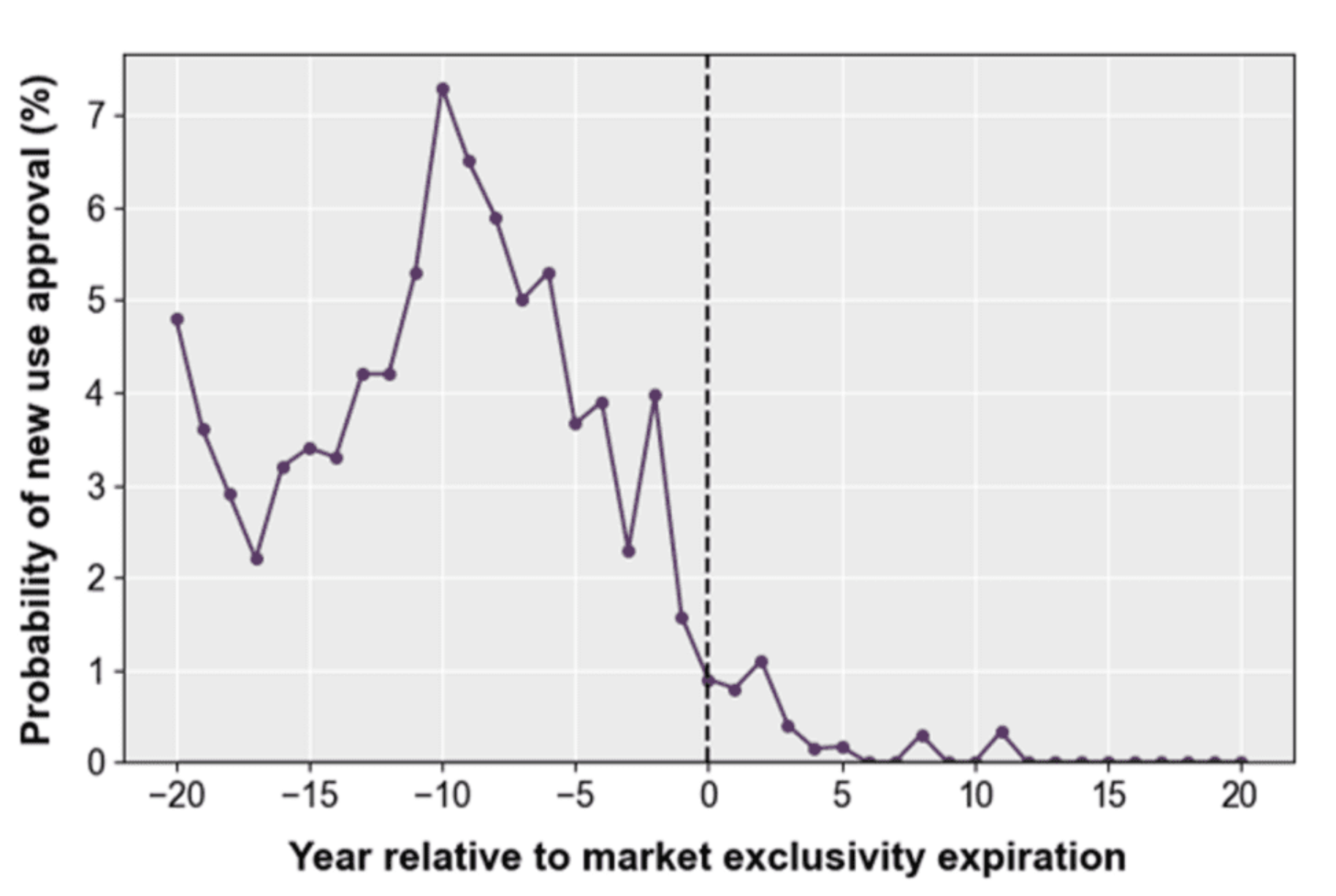
Empirical evidence corroborates the idea that there is an insufficient financial incentive to repurpose generic drugs. Recent analysis shows that the probability of a developer receiving approval for a new use falls as the end of market exclusivity approaches (see Figure 4). The same paper estimates that if developers were rewarded for repurposed drugs at levels similar to new patented medicines, there would be roughly 200 to 800 additional drug-condition combinations approved today.
Figure 4. The probability of approval for a new use decreases as market exclusivity expires
Source: Adapted from Budish, Durvasula, Roin, and Williams, 2026, Missing Markets for Innovation: Evidence from New Uses for Existing Drugs
4.2 Barriers to using FDA-approved drugs for unapproved uses
Even when a clinician decides it is appropriate to prescribe a drug for an unapproved use, several barriers limit access. First, without formal approval, insurance coverage is less likely, increasing out-of-pocket costs for patients and reducing access. Second, manufacturers generally may not promote an unapproved use of a drug to physicians, limiting their ability to inform clinicians about that use.
Researchers estimated that FDA approval raises adoption by about 40 percent overall (stated in the abstract) and up to 66 percent for new disease areas (derived from Panel B of Figure IV). Some of this is driven by the fact that FDA approval allows companies to educate physicians, which, in a separate analysis, was estimated to increase prescriptions by 8 percent.
Metformin for prediabetes illustrates how adoption can lag even when evidence is strong and included in treatment guidelines. The drug has shown significant health benefits and cost-savings potential, but is used in only ~2 percent of eligible patients.
4.3 FDA and federal partner response to barriers
In our response to Question 3, we articulate a mechanism that FDA, in collaboration with CMS and/or NIH, could use to address these barriers. Our core proposal is a pull mechanism that rewards drug developers based on the cost savings and/or health impact of newly repurposed generic drugs.
4.4 Collecting and using data about unapproved uses
FDA and federal partners could improve understanding of unapproved uses by linking prescription and claims data with selected electronic health records. Our proposal in Question 3 suggests using prescription and claims data to measure adoption and administer pull funding payments, but the same approach could be pursued independently to monitor use and inform research and policy.
1.For ease of reference, we call the repurposing of drugs no longer protected by composition-of-matter patents or relevant regulatory exclusivities “generic drug repurposing” and refer to those drugs as “generic drugs,” while recognizing that FDA uses the term more narrowly for products approved through an ANDA.
2.Researchers estimated that FDA approval raises adoption by about 40 percent overall (stated in the abstract) and up to 66 percent for new disease areas (derived from Panel B of Figure IV). Some of this increase in adoption is driven by the fact that FDA approval allows companies to educate physicians, which, in a separate analysis, was estimated to increase prescriptions by 8 percent.
3. A separate funding approach may be needed to incentivize generic drug repurposing during health emergencies, such as chemical, biological, radiological, or nuclear threats. Establishing that approach in advance would help the government deploy resources efficiently and effectively during a crisis, rather than hectically in real time. Such a mechanism could consier using platform or adaptive trials, which the United Kingdom used during COVID-19. The mechanism may be best administered by the Biomedical Advanced Research and Development Authority or relevant Department of Defense offices.
4.Grants may be appropriate for candidates with compelling, existing evidence, such as those identified in Scenario 2 of Question 2. However, grant funding will become less attractive as these “low-hanging fruit” are exhausted.
5.Importantly, much of this information remains private and may be difficult to elicit through regulations or project-specific grants alone. Federal law did not require widespread public reporting of clinical trial results until 2007, compliance is inconsistent, and required reporting generally only includes summary findings rather than richer patient-level data. Academic work, including “Trials and Terminations,” suggests that these data can have significant value. Companies also collect and spend billions of dollars to purchase additional real-world data, in part to inform new drug development.
6.Experience with improved cookstoves in low-income countries illustrates this risk. Technically “better” products failed because they did not meet users’ needs. Analogous concerns apply to paying for interim milestones. Milestone payments can support progress, but they do not necessarily ensure the final product is useful, usable, or widely adopted.
7. We used historical clinical trial data to estimate the reward needed to justify investment. We find that rewards on the order of several hundred million dollars in net present value per opportunity would likely be sufficient, depending on the strength of existing evidence. Stakeholder conversations informed our view of what would make participation worthwhile. A reward would not need to match new-molecule returns to interest pharmaceutical companies focused on R&D, since repurposing carries lower cost and risk. For generic manufacturers, other considerations matter, such as the labeling and liability responsibilities of sponsoring an approved new use. However, appropriately sizing the reward should help overcome those concerns.
8. We do not think the auction structure should be a major barrier to entry, even if some developers, particularly university and nonprofit researchers, are less equipped than larger companies to estimate the reward share needed to justify development. University researchers already rely on technology transfer offices and other advisors to negotiate with investors or industry partners for non-generic drug development, and they could rely on similar support here. Uncertain bidders could also simply bid at the auction ceiling, which may be sufficient because some opportunities may be uncontested.
9. The Department of Veterans Affairs (VA) and other federal payers like TRICARE could potentially play a useful supplemental role. The VA’s Center for Care and Payment Innovation (VA CCPI) has similar authority to CMMI under 38 U.S.C. § 1703E, added by Sec. 152 of the VA MISSION Act of 2018. However, it has important limits: (1) a spending cap of $50 million per year (Sec. 1703E(g)(2)(A)) and (2) a five-year maximum pilot duration (Sec. 1703E(b)). Because payers like the VA CCPI and TRICARE are much smaller than CMS, their savings alone are unlikely to independently motivate development.
10. Expert interviews with patent lawyers, medical doctors, economists, and staff at pharmaceutical companies have helped inform our understanding of the difficulty enforcing new-use patents and the subsequent effect on incentives.
Thank you for taking the time to read our response.
Christopher Snyder, Hyatt Professor of Economics at Dartmouth College and Faculty Co-director at the Market Shaping Accelerator
Akhil Bansal, Health Policy Fellow at the Market Shaping Accelerator and Internal Medicine Physician at the National Health Service
Hassan Sayed, Postdoctoral Scholar at the Market Shaping Accelerator
Sarrin Chethik, Senior Policy Analyst at the Market Shaping Accelerator